Ford has taken another major step toward its return to the top class of endurance racing. The manufacturer has confirmed the first drivers for its forthcoming FIA World Endurance Championship (WEC) Hypercar programme while revealing key technical details about the 2027 Ford Racing entry.
The announcements came during the brand’s annual Season Launch event at Michigan Central Station in Detroit, close to the marque’s historic base in Dearborn. At the event, Ford confirmed that its upcoming prototype will use a chassis designed and developed by the experienced French organisation ORECA.
Ford confirms naturally aspirated V8 at the heart of 2027 WEC Hypercar entry
The headline technical revelation centred on the powertrain. Ford will equip the car with a naturally aspirated 5.4-litre V8 engine produced entirely in-house with support from Red Bull Ford Powertrains. The engine shares its architecture with the Coyote unit used across the Mustang racing family and will operate alongside the spec hybrid system mandated by Hypercar regulations.
As a result, Ford’s challenger will become only the third non-turbocharged car expected on the FIA WEC Hypercar grid in 2027, joining the Cadillac V-Series.R and the Aston Martin Valkyrie.
Ford Racing Hypercar Programme Manager Dan Sayers reflected on the progress already made since the programme’s launch.
“One year ago, we made a promise to return to the top-flight of endurance racing,” commented Ford Racing Hypercar Programme Manager, Dan Sayers. “Today, we are 12 months away from being on the grid.
“In the world of global motorsport, that is a heart-stopping timeframe. To build a Hypercar programme from a blank sheet of paper to a Le Mans start-line in just two years is, by any objective measure, almost impossible, but at Ford Racing, making the impossible possible is the only way we know how to work. We have spent the last year in the trenches, and while the main event is still ahead of us, the soul of this machine is already beginning to roar.”
The importance of the Coyote engine
Sayers emphasised that the engine plays a defining role in shaping the character of the new Hypercar.
“That soul is the engine. It is more than just a component – it is the identity of the car. When you hear a Ford coming down the Mulsanne Straight at three in the morning, you shouldn’t have to look at the badge to know who it is. That’s why we chose the Coyote. When you have an engine this iconic in your arsenal – a powerplant that already defines our Dark Horse R, GT4 and GT3 programmes – you don’t look for alternatives. You lean into your DNA.”
A legacy at Le Mans
Ford’s Hypercar project carries deep historical significance for the brand. Nearly six decades have passed since the manufacturer last dominated the famous Circuit de la Sarthe, where the legendary GT40 secured four consecutive overall victories at the 24 Hours of Le Mans between 1966 and 1969, including a historic top-three lockout in the first of those triumphs.
More recently, the Ford GT claimed victory in the LMGTE Pro category in 2016. Ten years later, Ford now aims to compete once again for overall honours at the world’s most famous endurance race.
Ford confirms first drivers for 2027 WEC Hypercar entry
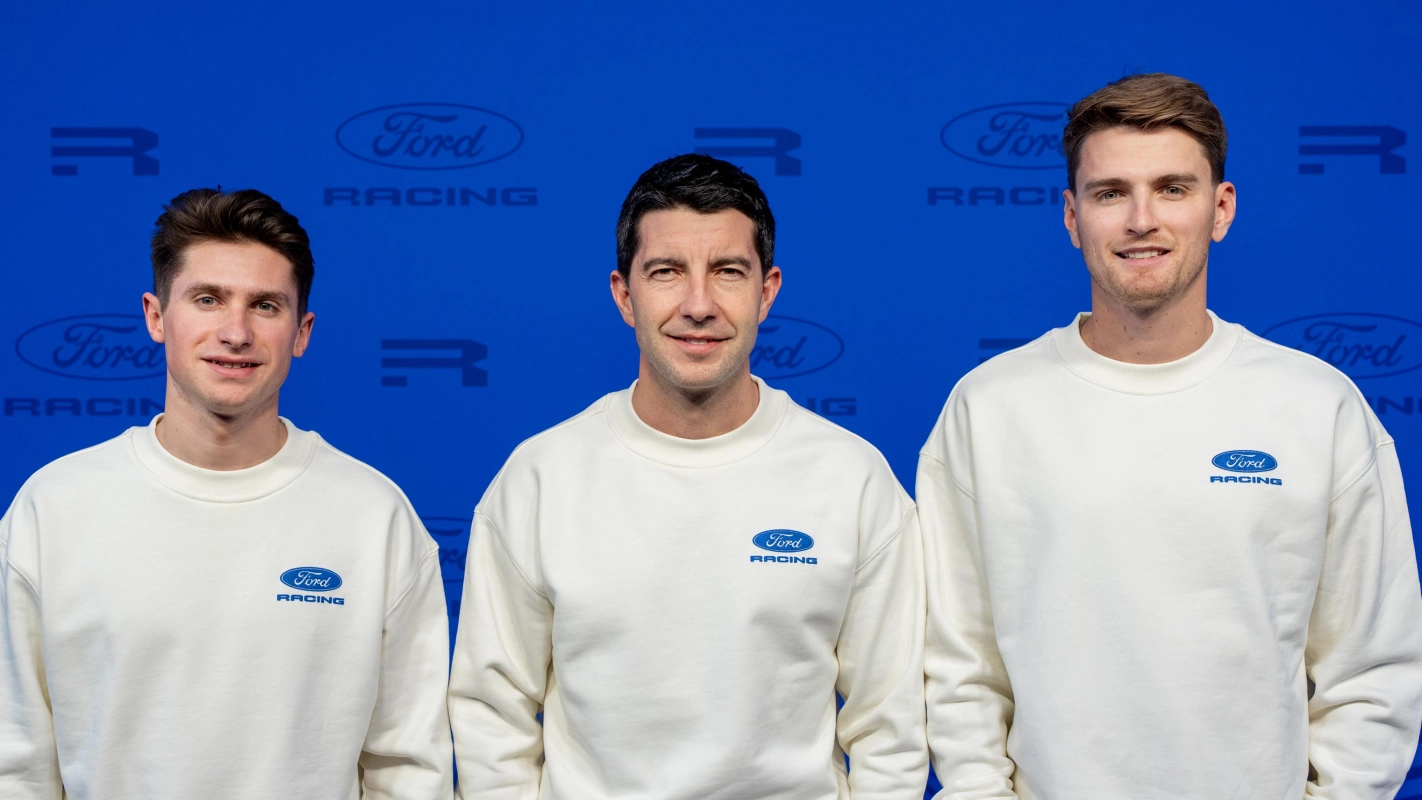
Alongside the technical announcements, Ford also revealed the first three drivers for the programme: Sebastian Priaulx, Mike ‘Rocky’ Rockenfeller and Logan Sargeant. The trio represents a deliberate blend of youth, experience and technical expertise as Ford prepares to enter a highly competitive Hypercar field.
Priaulx and Rockenfeller already share experience within the Ford ecosystem. In 2025, they teamed up in IMSA’s GTD Pro category with the Multimatic Motorsports-run Mustang. Victories in Detroit and at Indianapolis Motor Speedway helped them secure third place in the championship standings.
To strengthen their endurance credentials further, the pair will compete together in the LMP2 class of the European Le Mans Series this year.
Meanwhile, former Formula 1 driver Logan Sargeant earned his opportunity after impressing during a test with Proton Competition at the FIA WEC Rookie Test in Bahrain last November, where he drove the team’s podium-finishing Mustang LMGT3.
Building a programme for the future
Before the Hypercar programme launches in 2027, both Priaulx and Sargeant will also compete in Proton Competition’s LMGT3 campaign in 2026. Priaulx will partner fellow Brit Ben Tuck and American Eric Powell in the #77 entry, while Sargeant will join Giammarco Levorato and Stefano Gattuso in the sister #88 car.
Sayers explained the thinking behind Ford’s chosen line-up.
“Seb is a pure, natural talent, ‘Rocky’ is the veteran who has seen it all and won it all while Logan brings a level of technical sophistication and high-downforce experience that is vital for a programme of this scale,” remarked Sayers, describing the trio as ‘scientists as much
Sayers also highlighted the symbolic significance of including an American driver in Ford’s return to Le Mans.
“Having an American back in a Ford at Le Mans feels right. It’s a nod to giants like Dan Gurney and AJ Foyt, who showed the world in 1967 what happens when American grit meets global ambition.
“We aren’t waiting until 2027 to start fighting, though, he said, continuing, “We are building a team, refining our processes and earning our stripes in the real world. We are taking the building-blocks of this programme and stress-testing them under the most demanding conditions on the planet.
He concluded, “We have the engine, we have the drivers and we have the vision, but the work is far from over. We are building more than just a car – we are building a legacy, and reclaiming our seat at the top table of endurance racing.”