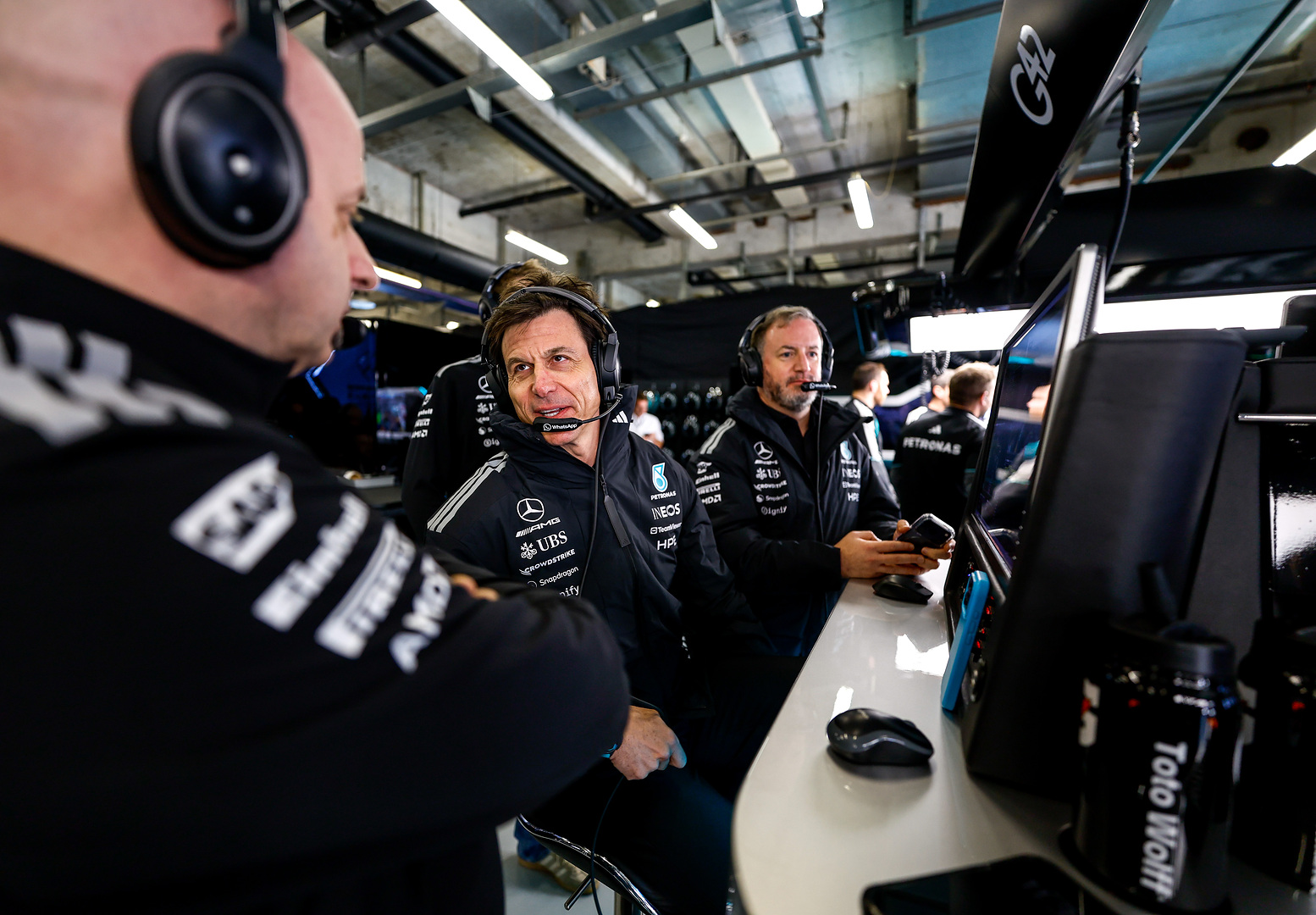
Mercedes F1 Team Principal Toto Wolff revealed a massive divide between the cockpit’s mechanical reality and the sport’s commercial success while discussing the 2026 regulations.
While Wolff monitored the 2026 data, the regulations continue to face backlash from the grid’s elite. He maintained a firm defence of the current direction. He prioritised the surging global engagement over the specific physical discomfort of the drivers.
The cockpit “horror show”
Red Bull driver Max Verstappen ignited the weekend’s primary controversy. He labeled the current regulations a “joke” and “fundamentally flawed” following a DNF at the 2026 F1 Chinese GP. The car looked nearly impossible to drive as well as balance limitations appeared once again for Red Bull Racing.
Wolff acknowledged the Dutchman struggles but is very much enjoying the racing he is seeing between Mercedes and Ferrari in 2026.
“I mean, Max is really, I think, in a horror show,” he stated. “While you look at the onboard that he has in qualifying yesterday, this is just horrendous to drive. And you can see that. But it’s not the same with many other teams.
“I think from an entertainment perspective, I believe that what we’ve seen today between Ferrari and Mercedes was good racing. Many overtakes. We were all part of Formula 1 where there was no overtake, literally.
“And sometimes, we’re too nostalgic about the good old years. But I think the product is good in itself.”
Physical limits and global growth
This “horrendous” experience is in part because of the complex energy management. Drivers must now manage significant throttle lifting even during high-stakes qualifying laps. This shift directly contradicts the traditional, flat-out nature of the sport.
Wolff suggested that some F1 teams might struggle more in the 2026 regulations more than others depending on their specific chassis.
“We saw quite some racing in the midfield also,” he remarked. “And that is, I think, the positive. Now, from a driver’s standpoint, when it comes to the balls-out qualifying lap, that is different. Clearly, lift and coast in the qualifying, I’m sure for someone like Max, who is a full-attack guy, it’s difficult to cope and digest.
“But it’s more, I would say, a car-specific issue that magnifies the problem that it is. Because if you sit in front of a TV or in front of a screen, even Max would say, that was interesting racing in the front.”
Wolff’s final verdict on the F1 2026 regulations
The core tension involves the complexity of throttle percentages required by the 2026 power units. While some drivers advocate for a return to simpler, faster qualifying, the regulations enables the race-day drama.
Wolff admitted that “qualifying flat-out would be nice,” yet he remained aligned with F1 CEO Stefano Domenicali.
“But when you look at the fans and the excitement that is there, the cheering when there’s overtakes and also on social media, the younger fans, the vast majority, through all the demographics, like the sport at the moment,” Wolff stated.
“So, yes, we can always look at how we’re improving it. But at the moment, all the indicators say and all the data say, people love it. And that’s why I spoke with Stefano. He says that too. So, it is driving the car that, for some, is not most pleasant.”
Under these F1 2026 regulations, Wolff emphasised that the show remained the priority.